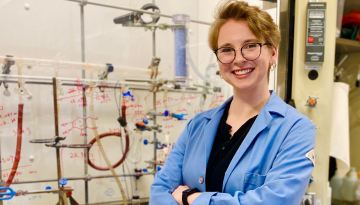
Beth Ryan, a graduate student in chemistry and chemical biology working in the Baskin Lab at Cornell’s Weill Institute for Cell and Molecular Biology, has been selected as a Young Scientist to attend the 74th Lindau Nobel Laureate Meeting dedicated to Chemistry, to be held June 2025 in Lindau, Germany.
The Varian Edge linear accelerator provides state-of-the art, non-invasive radiotherapy treatments. The closest comparable facilities are in New York City, and while approximately 40% of veterinary schools have radiation oncology programs, few have access to such technology. Cornell’s Varian Edge replaces machinery previously installed in 2000.
Since relocating to Upstate New York, Myanmar refugees’ relationship to fishing has shifted, from angling for food and nutrition to being a means for maintaining social connections, time outdoors and emotional well-being.
The vast agricultural landscape of the U.S. Midwest known as the Corn Belt acts as a barrier for migrating landbirds, causing them to adjust their flight behaviors similar to when crossing natural barriers like the Gulf of Mexico.
Flowers grow stems, leaves and petals in a perfect pattern again and again. A new Cornell study shows that even in this precise, patterned formation in plants, gene activity inside individual cells is far more chaotic than it appears.
Smolka, a biochemist and former interim director of the Weill Institute for Cell and Molecular Biology, will support life sciences across the university.