Professors address climate change from multiple disciplines

The June 6 panel, "Beyond the Apocalypse: New Narratives and Innovations for Climate Action," took place during Reunion 2025.

Around Cornell

Soft robotic gripper injects leaves with precision

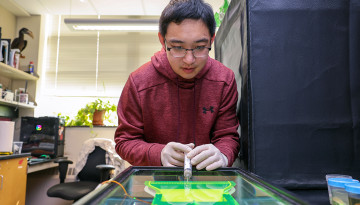
Cornell researchers have developed a soft robotic device that gently grips and injects living plant leaves with sensors that help it detect and communicate with its environment. The robot can also inject genetic material into the leaves.

Lewenstein wins science communication prize

The inaugural Award for the Advancement of Science Communication as a Professional Field from the International Network on Public Communication of Science & Technology recognizes outstanding contributions to the development of science communication as a field. 

Around Cornell

New York Times series features math by Prof Steven Strogatz

Strogatz has been busy with outreach activities as the inaugural Susan and Barton Winokur Distinguished Professor for the Public Understanding of Science and Mathematics.

Around Cornell

Cornell emerges as a leader in semiconductor innovation 

Gallox Semiconductors, a startup with Cornell Roots, won the 2025 Hello Tomorrow Global Challenge in the Advanced Computing & Electronics category. A member of the Praxis Center for Venture Development, Gallox is one of several semiconductor startups launched at Cornell.

Around Cornell

Biodegradable ‘heat bombs’ safely target specific cells

Cornell researchers developed a new way to safely heat up specific areas inside the body by using biodegradable polymers that contain tiny water pockets, a technology that could lead to precise and noninvasive diagnostics and therapeutics.

Microbes that extract rare earth elements also can capture carbon

Cornell geochemists and synthetic biologists have collaborated to improve the efficiency of microbes that can dissolve rocks to extract critical minerals while speeding carbon sequestration from air.

One tiny particle could complicate predictions of physics theorists

An international collaboration that includes Cornell researchers achieved a new level of precision in measuring the magnetic anomaly of the muon – a tiny, elusive particle that could have very big implications for understanding the subatomic world.

‘Stealthy’ lipid nanoparticles give mRNA vaccines a makeover

A new material developed at Cornell could significantly improve the delivery and effectiveness of mRNA vaccines – used to fight COVID-19 – by replacing a commonly used ingredient that may trigger unwanted immune responses in some people.