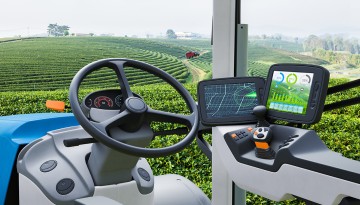
As the world seeks to avoid climate extremes, employing state-of-the art agricultural technology could result in more than 13 billion tons of net negative greenhouse gas emissions annually.
Cornell researchers unexpectedly discovered the presence of “quantum spin-glass” while conducting research designed to learn more about quantum algorithms and, relatedly, new strategies for error correction in quantum computing.
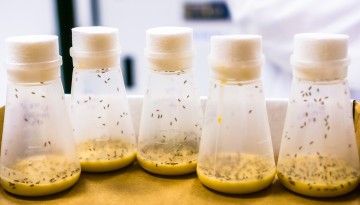
Cornell biologists report that fruit flies’ visual system, not just chemical receptors, is deeply involved in their social behaviors, which sheds light on the possible origin of differences in human social behaviors, such as those seen in people with autism.
Staff have reoriented international organizations to tackle climate change more aggressively despite member states’ disagreement on how to address the issue, new Cornell research finds.
A member of an important class of ion channel proteins can transiently rearrange itself into a larger structure with dramatically altered properties, according to a study led by researchers at Weill Cornell Medicine.
Research, policies and tools related to New York state wages, job creation and employment are all addressed in the New York at Work 2022-23 report, a compilation of research and policy briefs by ILR School researchers, published Aug. 29.
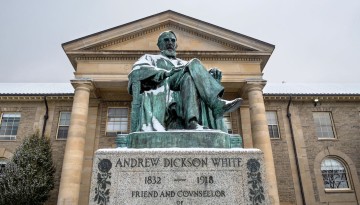
A quantum physicist and an environmental economist have been appointed the newest A.D. White Professors-at-Large, and five returning professors will visit campus this fall.
In two new papers, an international collaboration of researchers including Cornell physicists explain, on the microscopic level, why “Planckian” scattering of electrons occurs in some materials but not in others.
New research involving machine learning determined that the persuasive power of “symbolic status” from virtual badges in online debates has the potential to create an imbalance of power.