In a virtual ceremony May 24, this year's 37 Merrill Presidential Scholars, who represent the top 1% of graduating seniors, recognized the high school teacher and university faculty or staff member who most influenced their academic development.
Research led by Jonathon Schuldt ’04, associate professor of communication, found that a majority of the U.S. public is supportive of soil carbon storage as a climate change mitigation strategy, particularly when it’s viewed as “natural.”
Managers who are open to employee input are more likely to attract workers from other units in their organizations, according to a new study from John McCarthy and JR Keller in the ILR School.
Incentivizing online reviews can have a positive effect on a company’s bottom line, but the investment comes with risks, according to new research from Kaitlin Woolley, assistant professor of marketing.
A new study co-authored by Harry Kaiser, the Gellert Family Professor of Applied Economics and Management, finds that even a slight grocery tax-rate increase could lead to food insecurity for many U.S. households.
A phase 3 clinical trial of treatment for idiopathic pulmonary fibrosis, sponsored by Weill Cornell Medicine, could pave the way for cheaper studies that are easier to conduct.
Computer games designed by students in the Game Design Initiative at Cornell will be available for the public to try and critique at the annual Game Design Showcase, to be held virtually from 4-7 p.m. May 25.
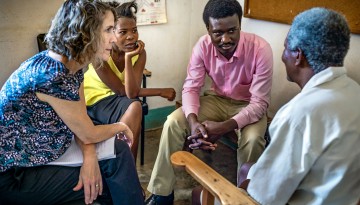
Through the Malawi Resentencing Project, the International Human Rights Clinic and Cornell Center on the Death Penalty Worldwide have helped dozens of death row prisoners win reduced sentences or release.
Cornell is partnering in a $36 million grant from the Toyota Research Institute for its Accelerated Materials Design and Discovery collaborative university research program, which seeks to use artificial intelligence to discover new materials that could help achieve emissions-free driving.