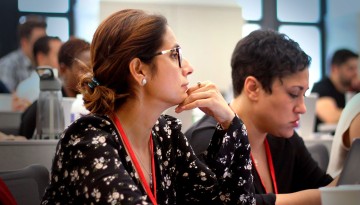
From Ithaca to Hawaii to Ecuador, students in the Robert S. Harrison College Scholars Program in the College of Arts & Sciences took advantage of the summer as a time to explore their research interests.
Students and lifelong learners are invited to explore a new interest, enhance their resume or strengthen their professional skills through Cornell’s Fall Part-Time Study Program, which runs Aug. 22 – Dec. 17, 2022. Registration for most students begins August 1.
Nexus Scholars working this summer with Juno Salazar Parreñas are studying how human health is intricately connected to the health of animals, plants and the environment.
New Cornell psychology research is the first to examine daily experiences of racial discrimination as a key stressor in the lives of African American couples.
Anti-fandom in the world of social media influencers can serve a social function by allowing people to critique norm transgressions, but it can also be a destructive force, a Cornell-led research team proposes.
New research by Professor Michele Belot indicates that a woman’s stress level while pregnant has a negative effect on the healthiness of her child’s diet.
Dr. Zubaida Qazi is earning an executive master’s in health administration in the Cornell Brooks School to enhance breast cancer prevention through her NGO, Pink Pakistan Trust.
Most people have waited until the last minute to complete a school assignment at some point in their lives, but a new study finds that first-generation students and those belonging to underrepresented ethnic and racial groups turn in assignments later, on average, than their nonmarginalized peers.