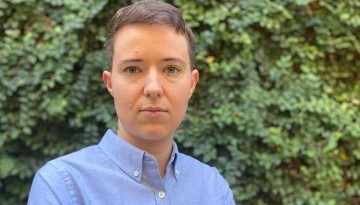
During a three-year Klarman Postdoctoral Fellowship, Amalia Skilton will study joint attention behaviors – which include pointing – by doing field work in Peru's Amazon basin.
As many as one in four children in Flint, Michigan – far above the national average – may have experienced elevated blood lead levels after the city’s 2014 water crisis, finds new research by Jerel Ezell, assistant professor in the Africana Studies and Research Center.
A team led by Natasha Holmes, the Ann S. Bowers Assistant Professor, set out to interview and survey physics undergraduates to see what role their preferences play in the well-documented gender disparities in physics lab courses.
The threat of demographic change may alter who white Americans perceive as racial minorities, potentially making more people vulnerable to discrimination, suggests new Cornell psychology research.
Professors Neil Lewis Jr. ’13 and Tashara Leak are leading the new Action Research Collaborative, which will serve as an institutional hub for cross-campus action research collaborations between Ithaca and New York City, and elsewhere.
As New York prepares for a carbon-free energy future, public support for utility-scale solar farms is much lower than support for smaller solar projects, says new Cornell research.
The seventh episode of a podcast hosted by Entrepreneurship at Cornell, Startup Cornell, features Laura Ciccone ‘11 and Taly Matiteyahu, co-founders of Blink, a voice-first blind speed dating app that helps people build meaningful connections based on genuine compatibility.
Following a sweeping effort in 2019 to address clinical care team well-being across Weill Cornell Medicine, physicians note a reduction in stress and feelings of burnout compared to previous surveys, according to a new report from the institution.
According to new Cornell research: Asking in person for help maximizes one’s chance of getting a “yes.” If you must ask from a distance, though, choose video or a phone call, rather than email or a text, the researchers found.