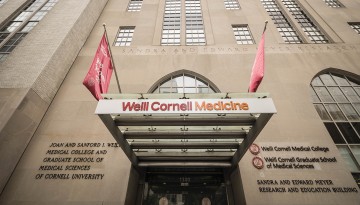
Weill Cornell Medicine's new Center for Comprehensive Spine Care exemplifies a different philosophy, offering patients centralized, multidisciplinary care in one building.
Finding new ways to study cancer and how it spreads is the goal of the Center on the Physics of Cancer Metabolism, a new translational research program between the College of Engineering and Weill Cornell Medicine.
With the goal of advancing Weill Cornell Medicine's mission to nurture the best future health care leaders, the Feil family has made a $12.5 million gift to establish a state-of-the-art student center.
The Dean's Entrepreneurship Lab provides resources and education opportunities to students and faculty who have ideas with commercial potential that they want to translate from the lab to the patient.
A gene essential for making blood vessels in embryos can successfully transform amniotic cells into therapeutic blood vessel cells, according to new research from Weill Cornell Medicine.
The university launched the Cornell Institute of Host-Microbe Interactions and Disease, an organization that connects the community of Cornell researchers studying host-microbe biology and disease.