Cornell experts have launched the Aging and Climate Change Clearinghouse to promote research, policies and activism addressing the need to protect vulnerable older adults in the face of climate challenges.
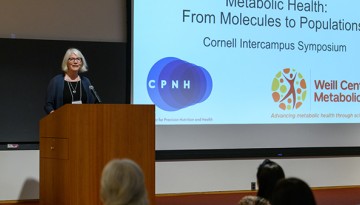
On Sept. 11 and 12, nearly 100 researchers from the Ithaca Campus and the Weill Cornell Medicine Campus in New York City came together for the symposium, Metabolic Health: From Molecules to Populations.
Researchers at Weill Cornell Medicine have found that radiation therapy combined with two types of immunotherapy can control tumors in preclinical models of triple-negative breast cancer, which is typically resistant to immunotherapy alone.
Weill Cornell Medicine has received a three-year, nearly $6 million grant from the Eunice Kennedy Shriver National Institute of Child Health and Human Development to lead one of three national contraceptive research centers.
An interdisciplinary team led by Cornell has received a five-year grant to launch a new center for engineering, testing and commercializing point-of-care diagnostic devices that will have international reach.
Craniosynostosis, the premature fusion of the top of the skull in infants, is caused by an abnormal excess of a previously unknown type of bone-forming stem cell, according to a preclinical study led by researchers at Weill Cornell Medicine.
Weill Cornell Medicine has been awarded a five-year, $5 million grant from the U.S. Department of Health and Human Services to study whether a bilingual video game can increase the use of contraception among Black and Hispanic adolescents.