The Cornell Prison Education Program has launched two national initiatives to address the data and research challenges facing programs that provide higher education in prisons.
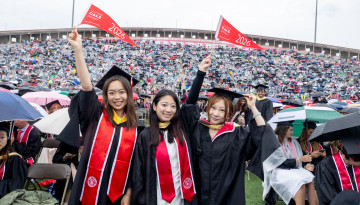
The Class of 2026 has the tenacity, talent and determination to advance the unfinished work of American democracy, President Michael I. Kotlikoff told graduates and their guests at Commencement ceremonies held May 23.
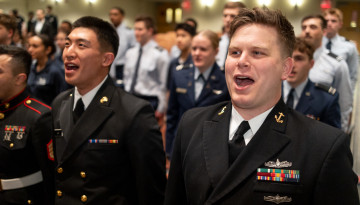
Two prior enlisted personnel were among 23 graduating Cornell seniors to receive commissions as second lieutenants or ensigns during campus ceremonies on May 21-22.
The Center for Teaching Innovation's Graduate Teaching Fellows program is celebrating 15 years of supporting the next generation of professors with graduate training to help them prepare for their future teaching.
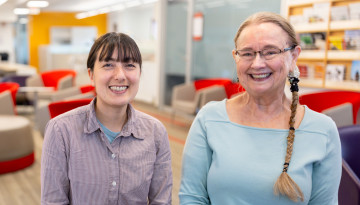
At Cornell, learning isn’t confined to classrooms. It emerges through conversations, relationships, and shared curiosity — and it belongs to everyone. That idea sits at the heart of the Community Learning and Service Partnership (CLASP), a program that connects Cornell students with staff in collaborative, one-on-one learning partnerships.
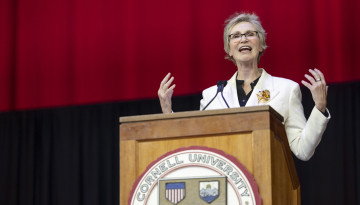
In her Senior Convocation address on May 21 in Barton Hall, Jane Lynch, MFA ’84, told the Class of 2026 to do their best to overcome their fears, don’t subscribe to cultural memes, and be kind and generous.
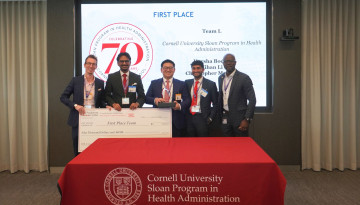
A team from Cornell University’s Sloan Program in Health Administration earned first place at the Cornell Sloan Program in Health Administration National Case Competition hosted by the University of Texas MD Anderson Cancer Center.
In his new book, Art faculty Nicholas Muellner looks for ways to move forward in life and creative practice while surrounded by the crises and complexities of our current cultural moment.
Large numbers of college students are now using artificial intelligence to complete – and cheat on – their assignments, suggesting that colleges and universities need to change how they are evaluating students.