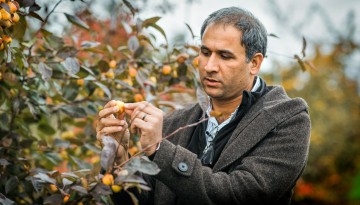
A $779,000 grant from the U.S. Department of Agriculture’s National Institute of Food Agriculture will help Cornell researchers prevent fire blight disease in apples and pears before it starts.
Graduate students in six fields of study have designed an evolution lesson on speciation for undergraduate non-majors that applies active-learning techniques. The lesson was published in CourseSource.
Environmental scientist Benjamin Z. Houlton, the new dean of the College of Agriculture and Life Sciences, says agriculture is the most important industry of the 21st century – and a powerful weapon to combat climate change.
Equipped with Zoom rooms and social distancing tools in the age of COVID-19, a group of students is demystifying the mechanics of voter registration and casting a ballot.
Four Cornellians have been appointed to three climate advisory panels that will inform the NYS Climate Action Council to draft a plan toward a zero-carbon state economy by 2050.
A new study in mice identifies a gene that is critical for short-term memory but functions in a part of the brain not traditionally associated with memory.
The Braudy Foundation – founded by Bob Braudy ’65, M.Eng. ’66, and his wife, Judi – has committed to funding a second five-year phase of a research collaboration between Cornell and Northern Arizona University.
Ecologists Aaron Rice and Amanda Rodewald are working with Migrations: A Global Grand Challenge, part of Global Cornell, to understand how human impacts and activities affect animals and the ecosystems we all share.