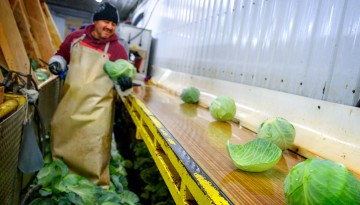
Trained Cornell Cooperative Extension agents teamed with New York State Department of Agriculture and Markets personnel across the state to offer free and confidential on-farm readiness reviews to insure that farmers can meet new produce safety standards.
Soil scientist Johannes Lehmann and Nathaniel Stern ’99 collaborated on experimental pyrolysis techniques to “age” modern technology and media – cellphones, laptops, tablets, floppy disks – for Stern’s art exhibit in Milwaukee.
The “Leadership Skills for Success” workshop, March 24-25 in the Stocking Hall Conference Center, promises to help participants develop the critical communication and supervisory skills needed to build and lead their teams.
Recyclable plastic containers with the No. 2 designation could become even more popular for manufacturers as plastic milk jugs, dish soap and shampoo bottles may soon get an environmental makeover.
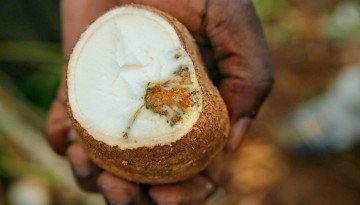
Alfred Ozimati, Ph.D. ’18, is breeding the latest in disease-resistant cassava that meets the needs of subsistence farmers, thanks to the NextGen Cassava project run by Cornell.
Combining observations from human bird watchers with topographical information satellites and information about light at night, the Cornell Lab of Ornithology’s eBird program has just released animated migration maps.
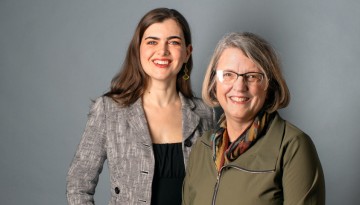
Caitlín Barrett and Kathryn Gleason ’79 have been collaborating since 2016 on the excavation and survey of a large house and garden site, the Casa della Regina Carolina Project, at Pompeii in southern Italy.
Cornell researchers have described a new type of gene drive with the potential to delay resistance that wild populations employ to fend off the genetic engineering of desired mutations.