Eleven early-career faculty members from six colleges and schools will participate in yearlong fellowships advancing ambitious research projects in the social sciences.
Cornell faculty members are finding answers to questions related to a world on the move with a boost from Cornell’s first Migrations grants, awarded by the “Migrations” Global Grand Challenge.
The new school and superdepartments in economics, psychology and sociology are expected to elevate Cornell’s excellence and impact in the social sciences.
The four faculty teams that received funding support through the President’s Visioning Committee on Cornell in New York City have conducted cross-campus workshops, hosted interdisciplinary talks and expanded their outreach.
Researchers from Cornell and Pennsylvania State University are developing a high-tech, portable imaging system that will increase profits and yields by making winter grapevine pruning more efficient.
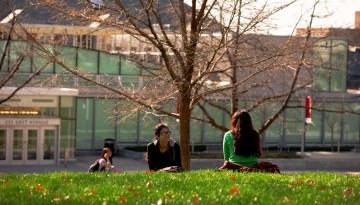
New research from an interdisciplinary Cornell team has found that it takes as few as 10 minutes in a natural setting for college students to feel happier and lessen the effects of stress both physically and mentally.
Events at Cornell include a cat video festival; performances inspired by Taiwanese artist Tong Yang-Tze; a concert and master classes with the Chamber Society of Lincoln Center; and a celebration of Robert Moog.
Cornell researchers have found a new species of soil bacteria – which they named after their late colleague, who first discovered it – that is particularly adept at breaking down organic matter.