Researchers have created a computer model that can help produce farms and food processing facilities control COVID-19 outbreaks, keeping workers safe and the food chain secure.
Cornell’s incubator Class of 2025, composed of startups Llume, Meiogenix and TETmedical, is advancing innovations in human performance monitoring, non-GMO plant breeding and neurological critical care.
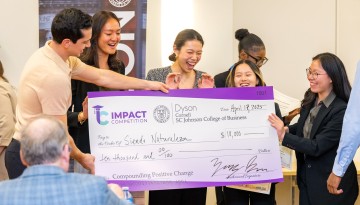
Six student teams tackling problems ranging from growing sustainable crops in the Amazon to subsidizing music lessons in Ithaca were awarded $22,500 to in this year’s Grand Challenges Impact Competition, April 17 in Warren Hall.
In the U.S., strategically converting a small fraction of land used to grow corn for ethanol to solar facilities could vastly increase energy production per hectare, as well as provide ecological benefits and financial resiliency for farmers.
Sixteen doctoral candidates traveled from the Ithaca campus and Weill Cornell Medicine in New York City to Capitol Hill April 9 for the annual Cornell Ph.D. Student Advocacy Day.
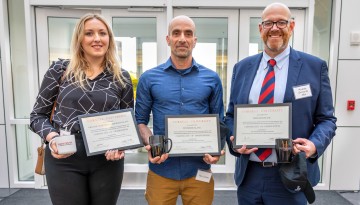
The third annual Community Engagement Awards brought together students, faculty, staff and community partners to celebrate the power of collaboration and connection. Hosted by the Einhorn Center for Community Engagement on April 8 in the Statler Hotel Ballroom, the event recognized the diverse and far-reaching efforts of those working to create positive change in Ithaca and around the world.
A new study, published in Global Change Biology, presents five case studies that demonstrate how deep collaboration can transform crop monitoring, fertilizer use and water management to tackle the most significant challenges facing farming: water status, fertilizer systems and phosphorus recovery.