Cornell’s Society for the Humanities will kick off its 2022-23 theme of “Repair” with a community read of “The Gayogo̱hó꞉nǫɁ People in the Cayuga Lake Region. A Brief History” by Kurt Jordan, associate professor of anthropology in the College of Arts and Sciences.
For the first time since 2019, the Cornell Lab of Ornithology’s free Migration Celebration – marking the biannual phenomenon of bird migration – is being held as an in-person event.
The New York State Department of Agriculture and Markets, in partnership with Cornell AgriTech, has launched a revitalized grapevine certification program to provide growers in New York and North America with clean, virus-tested plant material verified by the most stringent testing standards in the world.
A tiny but important area in the middle of the brain acts as a switch that determines when an animal is willing to work for a reward and when it stops working, according to a new study.
U.S. Senator Kirsten Gillibrand, a member of the Senate Agriculture Committee, visited Cornell Aug. 29 to champion agricultural conservation and climate-smart farming provisions in the Inflation Reduction Act and highlight related research and extension efforts in the College of Agriculture and Life Sciences.
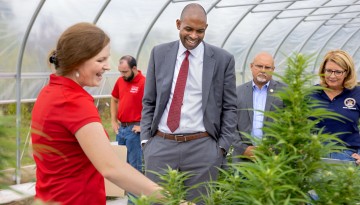
Public investment in agricultural research supports farmers, food security, economic development and environmental sustainability, Cornell researchers told New York Lt. Gov. Antonio Delgado during a tour Aug. 26 of Cornell AgriTech facilities in Geneva, New York.
The Presidential Advisors on Diversity and Equity have awarded three Belonging at Cornell innovation grants for 2022 programming, for projects addressing a range of topics involving diversity, equity and inclusion on all of Cornell’s campuses.
National 4-H Council awarded New York Gov. Kathy Hochul its Distinguished Alumni Medallion. Cornell Cooperative Extension runs the venerable youth program throughout the state.