A dozen graduating ROTC seniors were among 19 members of Cornell's Tri-Service Brigade who earned commissions in the Army, Navy, Air Force and Marines during a May 27 ceremony in Alice Statler Auditorium.
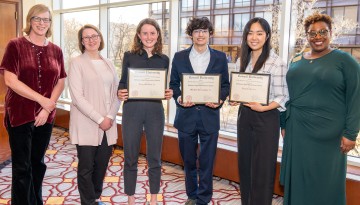
Matthew Borinshteyn ’25, Jennifer Lee ’23 and Avery MacLean ’22 received the 2022 Robinson-Appel Humanitarian Awards in recognition of their significant involvement in community service.
Cornell startup Antithesis Foods and Bactana were awarded NSF small-business grants, as Guard Medical raises $11 million in Series B investments and C2i launches a disease test in Europe.
Mitigation strategies must target carbon dioxide alongside other largely neglected climate pollutants in order to stay below catastrophic climate tipping points.
While they value in-person interactions, undergraduate students want to keep some of the adaptations developed during online teaching, including online assignment submission and digital question answering, survey research finds.
Scientists soon will see Earth’s atmospheric dust in high-resolution, thanks to new spectrometer expected to launch June 7 aboard a SpaceX rocket to the International Space Station.
Production of animal protein in China has increased by 800% over the past 40 years, but new research shows why the amount of climate-warming nitrous oxide released from this animal farming has not risen as quickly.
The nutrient choline – shown to have long-term benefits for children whose mothers consume it during pregnancy – also helps the body more efficiently use an omega 3 fatty acid that is essential for fetal development.