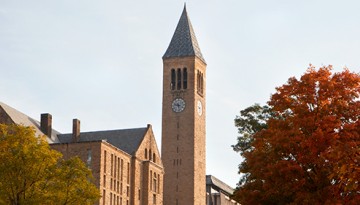
President Martha E. Pollack announced the eight winners of the Stephen H. Weiss Awards Oct. 18. The awards recognize members of the faculty for excellence in teaching undergraduate students and contributing to undergraduate education at the university.
More than 100 Cornell faculty and staff members, plus graduate and undergraduate students, explored methods for collecting, sharing, protecting and understanding data in Day of Data, at the ILR Conference Center.
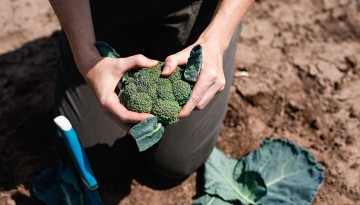
The Eastern Broccoli Project began in 2010 with the goal of growing a $100 million broccoli industry in the Eastern U.S. in 10 years. With two remaining years of funding, Cornell researchers say they are on schedule to meet their goal.
Cornell will lead a new global crop improvement research program to advance plant breeding tools, technologies and methods aimed at delivering staple crops that can increase yields, enhance nutrition and show greater resistance to pests and diseases.
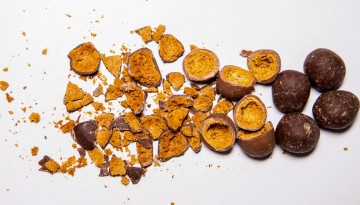
Antithesis, a Cornell student startup, was recently awarded a $225,000 Small Business Innovation Research Phase I award from the National Science Foundation to develop its chickpea-based snack food.
This past summer, Cornell landscape architecture students examined complicated redevelopment questions regarding post-industrial sites in New York City and designed their own projects.
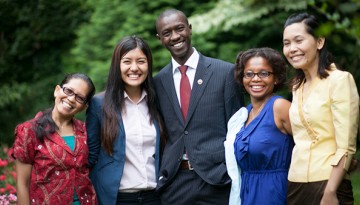
On Oct. 22-23, Cornell’s Humphrey Program will celebrate 40 years of enriching the professional experience of more than 400 people from 111 countries, who’ve come to Cornell for a yearlong exchange.
Women and underrepresented faculty members engaging in life science scholarship have until Nov. 11 to apply for a grant from the Schwartz Research Fund for Women and Other Underrepresented Faculty in the Life Sciences.
The Department of Entomology on Oct. 19 will host Insectapalooza, an annual extravaganza that aims to take the “creepy” out of “creepy-crawly.” This year’s event is from 9 a.m. to 3 p.m. at Stocking Hall – and it’s free.