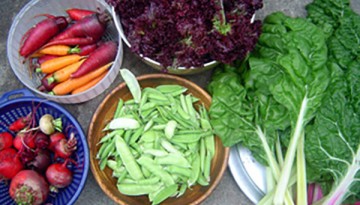
In 2007, Cornell's Homer C. Thompson Research Farm in Freeville donated a record 178,000 pounds – or about 82 tons – of fresh produce, more than double what the research farm gave away in 2004, to three local food banks.
Understanding survival of a species can be a lot more complicated than meets the eye because ecosystems are so interrelated. In a recent study, a Cornell researcher discovered that host caterpillars that eat fungus-infected plants harbor more female than male wasp larvae by 2-to-1.
The National Academy of Sciences will present Professor Thomas Eisner, a world authority on animal behavior, ecology and evolution, with the 2008 John J. Carty Award for the Advancement of Science at an April ceremony.
Duncan Hilchey of Cornell's Community and Rural Development Institute says northern New York is selling more food directly to consumers, but more needs to be done. (Jan. 22, 2008)
In 'George F. Warren: Farm Economist,' Cornell Professor Emeritus Bernard 'Bud' F. Stanton details Warren's life and legacy as a key adviser to President Roosevelt and a leader in developing the field of farm management.
Now is the perfect time to curl up with seed catalogs and pick vegetable varieties for summer gardens. To see how various varieties have worked out for thousands of other gardeners, check out Cornell's Vegetable Varieties for Gardeners Web site. (Jan. 21, 2008)
A new study has identified a set of genetic variants in maize that accounts for levels of vitamin A precursors among varieties. The discovery could lead to at least tripling provitamin A levels in maize in Africa, where millions go blind due to vitamin A deficiency. (Jan. 17, 2008)
Professors Ross Brann, Albert George and David Winkler have been chosen for the 2007 Stephen H. Weiss Presidential Fellowships for excellence in teaching and advising undergraduate students. (Jan. 16, 2008)
Cornell and Yale universities will share a $5.5 million, four-year grant from the National Science Foundation for research to better understand the biology of rice, maize and sorghum, among other crops. (Jan. 16, 2008)