The film focuses on the gendered implications of deepfake technology; a free screening Feb. 7 will be presented by the Milstein Program in the College of Arts and Sciences, partnering with Cornell Cinema.
The Association for Computing Machinery (ACM) has named three Cornell Bowers CIS faculty as 2023 ACM Fellows in recognition of their outstanding accomplishments in computing and information technology.
Ann S. Bowers ’59, a pioneering tech executive and longtime philanthropist whose transformational gift established the Cornell Ann S. Bowers College of Computing and Information Science, died Jan. 24 in Palo Alto, California. Bowers was 86.
A mathematician who has advised states and litigants on redistricting legislation will explore in a Feb. 5 lecture whether race-blind, computational approaches to law and policy can improve fairness.
The National Academy of Sciences has selected Eshan Chattopadhyay, assistant professor of computer science, as the 2024 co-recipient of the Michael and Sheila Held Prize for his novel work on randomized algorithms.
Kilian Weinberger and Claire Cardie join five of their Cornell colleagues in being named AAAI Fellows, in recognition of their significant contributions to the field of artificial intelligence.
A multidisciplinary task force of Cornell faculty and staff has issued a report offering perspectives and practical guidelines for the use of generative artificial intelligence in the practice and dissemination of Cornell’s academic research.
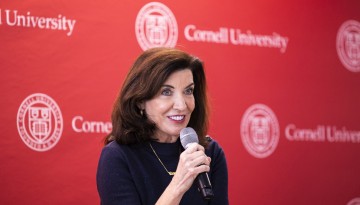
A consortium aiming to make New York a global leader in artificial intelligence would help Cornell play a role in shaping the future of AI, promote responsible research and development, create jobs and unlock opportunities focused on public good.
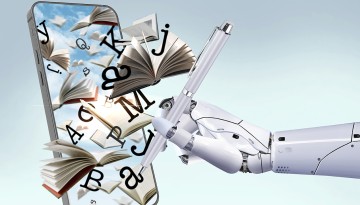
Ask ChatGPT to find a well-known poem and it will probably regurgitate the entire text verbatim – regardless of copyright law – according to a new study by Cornell researchers.