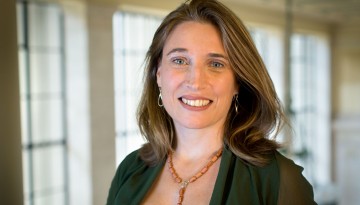
Krystyn J. Van Vliet, currently associate provost and associate vice president for research at the Massachusetts Institute of Technology, will join Cornell in 2023 as vice president for research and innovation.
Researchers studying carbon removal and storage methods and novel additive manufacturing techniques are among the six Cornell faculty members who recently received National Science Foundation Faculty Early Career Development Awards.
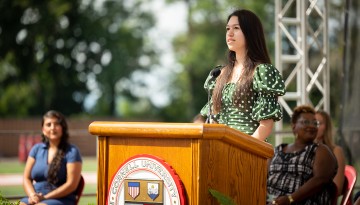
Hundreds of first-year and transfer students were heaped with advice, encouragement and well-wishes at New Student Convocation, held Aug. 21 at Schoellkopf Field.
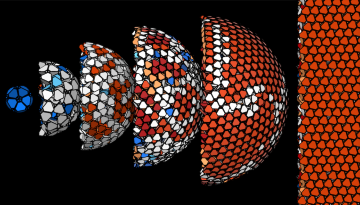
Researchers at Cornell used computer simulations to show how the assembly of a complex particle shape is affected when confined inside a spherical container. The findings offer scientists a new method for controlling the assembly structure of the resulting material.
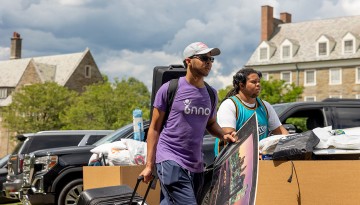
As the residence halls honoring Ruth Bader Ginsburg, Hu Shih and Barbara McClintock opened, resident advisers handed these newest Cornellians their room keys – and their futures.
A group of international scientists led by Cornell is evaluating how the stratosphere could be made just a little bit brighter, reflecting more sunlight so that Earth maintains its cool.
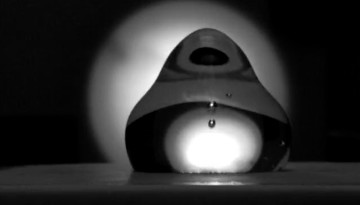
An experiment on the International Space Station has given Cornell researchers fresh insight into the ways that water droplets oscillate and spread across solid surfaces.