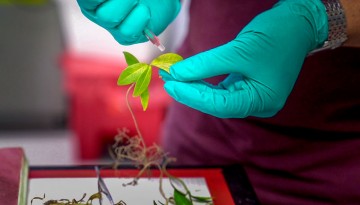
A breakthrough technology uses nanoscale sensors and fiber optics to measure water status just inside a leaf’s surface, providing a tool to greatly advance our understanding of basic plant biology, and opening the door for breeding more drought-resistant crops.
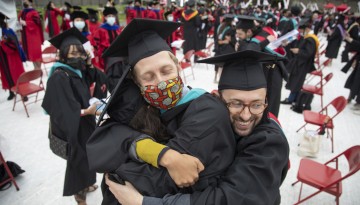
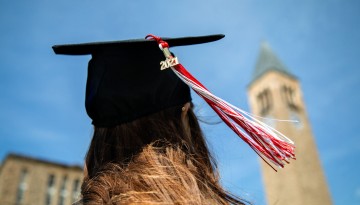
Four Commencement ceremonies were held May 29-30, spaced out to meet health guidelines. Though campus was less crowded, the campus mood was warm and celebratory.
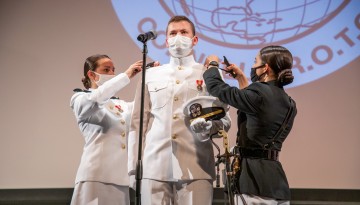
In a hybrid ceremony May 28 in Bailey Hall, 21 graduating members of Cornell’s Reserve Officers’ Training Corps received commissions as officers in the Army, Navy, Air Force and Marines.
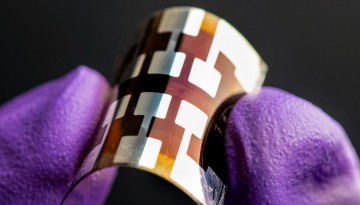
Cornell engineers are the first to study thermal transport in 2D hybrid perovskites – a new class of materials with promising applications for photovoltaics and thermoelectronics.
The Cornell China Center has announced six new grant awards, totaling $140,000, to support research by Cornell faculty teams partnering with researchers in China.
In a virtual ceremony May 24, this year's 37 Merrill Presidential Scholars, who represent the top 1% of graduating seniors, recognized the high school teacher and university faculty or staff member who most influenced their academic development.
The School of Civil and Environmental Engineering will offer an optional smart cities undergraduate concentration, recognizing the growing ubiquity of sensors, smart devices and real-time data in related fields.
PARADIM has received a second award of $22.5 million from the National Science Foundation to fund another five years of enabling scientists, engineers and entrepreneurs nationwide to design and create new inorganic materials for use in electronics.
This weekend’s ceremonies for Cornell’s 153rd graduating class will look different due to COVID-19 safety precautions and protocols – but they promise to be as memorable and meaningful as ever.