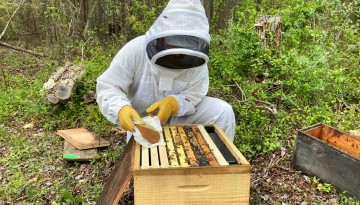
A Cornell-developed technology provides beekeepers, consumers and farmers with an antidote for deadly pesticides, which kill wild and managed bees that pollinate crops.
Cornell's Adult University invites alumni, their friends and family, and the general public to expand their minds this summer by taking live, online courses for adults and youth taught by Cornell faculty and graduate students.
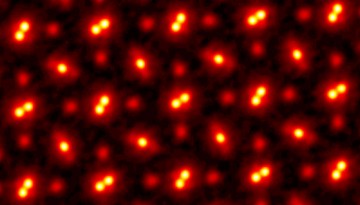
Cornell researchers have topped their own record for atomic resolution with an electron microscope pixel array detector that incorporates sophisticated 3D reconstruction algorithms.
An interdisciplinary team of Cornell researchers has created a cohort of new quantum metamaterials that can achieve superconductivity at temperatures competitive with state-of-the-art solid-state materials synthesis.
After a strong 30-year relationship, the Vietnam Veterans of America honored Cornell ROTC – the Tri-Service Brigade – with a state-level and national award.
Cornell is partnering in a $36 million grant from the Toyota Research Institute for its Accelerated Materials Design and Discovery collaborative university research program, which seeks to use artificial intelligence to discover new materials that could help achieve emissions-free driving.
Cornell engineers and plant scientists have teamed up to develop a low-cost system that allows grape growers to predict their yields much earlier in the season and more accurately than costly traditional methods.
Cornell engineers used laser pulses to control changeable properties in a quantum material, pioneering a method that may have wide applications across a class of materials with immense technological interest.