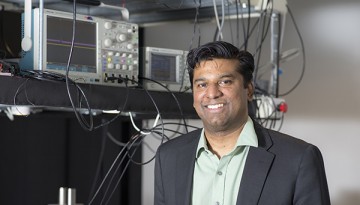
Meredith Silberstein, assistant professor in the Department of Mechanical and Aerospace Engineering, will receive $150,000 a year over the next five years through a Department of Energy early-career program.
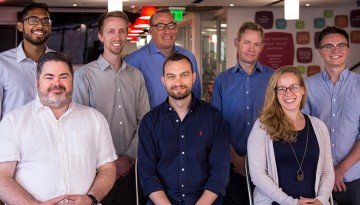
Doctoral students in Cornell Engineering’s Commercialization Fellowship are developing tools to compress laser pulses, separate blood plasma and 3D print living tissue.
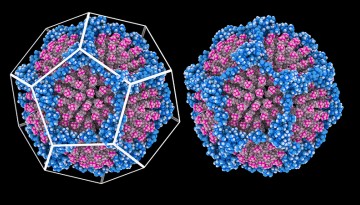
A cross-campus collaboration led by materials science professor Uli Wiesner results in visual confirmation of 12-sided, nanoscale cage structures, which could have medical diagnostic and therapeutic applications.
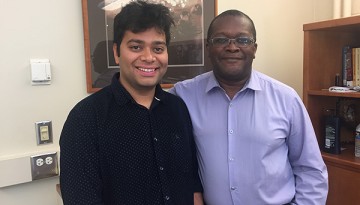
A group led by chemical engineering professor Lynden Archer and Snehashis Choudhury, Ph.D. '18, proposes a new way to think about the electrolyte structure of a lithium metal battery.
Ilana Brito, assistant professor of biomedical engineering, has been named a Pew Scholar in the Biomedical Sciences. Brito will receive a four-year, $300,000 grant to further her study of the human microbiome.
Dynamic Boundaries, a startup that aims to relieve pain and improve mobility for patients suffering from severe osteoarthritis, joined Cornell’s McGovern Center, a business incubator, June 1.
Humanity may forfeit the chance to save North Atlantic right whales from extinction if conservation policies are not drawn up and implemented fast, says a new Cornell study in Oceanography.
A microscopy technique developed in the lab of assistant professor of biomedical engineering Steven Adie could change the way biomedical researchers study the movement of cancer cells, among other applications.