President Martha E. Pollack has established a task force to interrogate all aspects of the undergraduate admissions process and to recommend a universitywide admissions policy and best practices that will be guided by Cornell’s founding mission and can be adapted by the admissions offices of each school and college.
Data science, molecular mechanisms, unconventional computing for optimization and machine learning, wave interaction with engineered materials, electrocatalysis, and compound semiconductor devices are among some of the research themes that helped six faculty members earn Cornell Engineering Research Excellence Awards.
Associate Professor Greg McLaskey ’05 and members of his Cornell Engineering research group have developed a method for mimicking aftershocks, findings that eventually could help scientists better predict earthquakes.
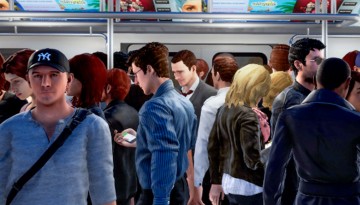
Testing time perception in an unusually lifelike setting – a virtual reality ride on a New York City subway train – an interdisciplinary Cornell research team found that crowding makes time seem to pass more slowly.
A Cornell-led collaboration used machine learning to pinpoint the most accurate means, and timelines, for anticipating the advancement of Alzheimer’s disease.
The 12th annual Cornell Town-Gown Awards – also known as the TOGOs – celebrated cooperation between the university and the greater Ithaca community at a virtual ceremony held Nov. 19.
For nearly six decades, Cornell’s Laboratory of Plasma Studies has remained at the forefront of plasma science – a tradition its incoming director, Gennady Shvets, professor of applied and engineering physics, plans to continue while also broadening the lab’s research capabilities.
The Graduate school welcomed over 80 new Dean’s Scholars into the community of over 370 current Dean’s Scholars at Cornell. The Dean’s Scholars program honors recipients of competitive, diversity-focused fellowships.