Shaoyi Jiang, the Robert Langer ’70 Family and Friends Professor and a world-renowned expert in biointerfaces and zwitterionic materials, has been recognized with a special issue of the journal Langmuir dedicated to his research and lasting impact on the field.
The NSF, in partnership with Intel, will invest $20 million over five years to establish the Artificial Intelligence Materials Institute at Cornell, as part of the National Artificial Intelligence Research Institutes.
Cornell researchers have uncovered a microscopic layer of carbon contamination, often left behind by air exposure and fabrication techniques, that impairs electrical flow in devices made with gallium oxide. They also found a solution.
Using custom-built computer simulations, Cornell researchers have visualized solid-solid phase transitions in unprecedented detail, capturing the motion of every particle in a theoretical material as its crystal structure morphs into another.
A Cornell Engineering team was on the cusp of significant progress developing an advanced laser useful for military and civilian applications, but a stop-work order prevented final experiments from proceeding.
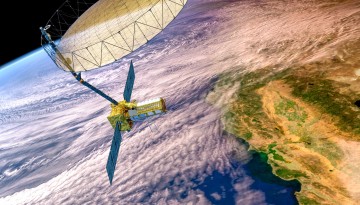
NASA and the Indian Space Research Organization are launching a satellite that uses synthetic aperture radar – and Cornell expertise – to monitor nearly all the planet’s land- and ice-covered surfaces twice every 12 days.
Cornell has secured a 10-year, $10 million grant renewal to continue work aimed at spurring economic impact and job growth through applied research, development and commercialization of breakthrough technologies.
Researchers have developed a rapid, cell-free method for building nanoparticle vaccines that mimic viruses at the molecular level, a technique that could pave the way for faster, more adaptable immunization strategies against deadly viruses like Nipah.
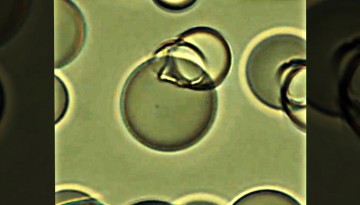
Cornell researchers have developed a two-phase liquid crystal system that can rapidly change – and hold – its shape, transforming from a transparent thin liquid film to an opaque emulsion, and then back again, all with a brief jolt of a high-frequency electric field.