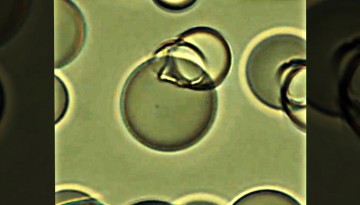
Cornell researchers have developed a two-phase liquid crystal system that can rapidly change – and hold – its shape, transforming from a transparent thin liquid film to an opaque emulsion, and then back again, all with a brief jolt of a high-frequency electric field.
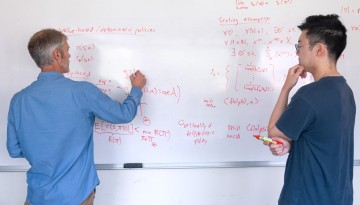
Cornell researchers have been building decision-support tools, optimization methods and artificial intelligence approaches to help the U.S. Navy and Marines quickly and effectively transport people and supplies – including blood for transfusions – in the event of an overseas conflict or humanitarian disaster.
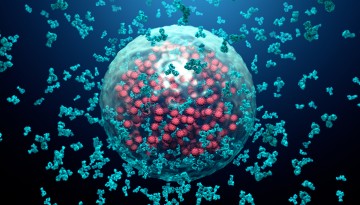
Cornell chemistry and chemical biology researchers have found a new and potentially more accurate way to see what proteins are doing inside living cells — using the cells’ own components as built-in sensors.
Researchers at the Cornell Ann S. Bowers College of Computing and Information Science have developed an AI-powered process that automatically transforms a short video of a room into an interactive, 3D simulation of the space.
Overconfidence is a hallmark trait of people who believe in conspiracies, and they also significantly overestimate how much others agree with them, Cornell psychology researchers have found.