The Amit Bhatia ’01 Global Ph.D. Research Scholars program is supporting doctoral students in completing extended, in-country international research essential for the completion of their dissertations.
Using experiments with COVID-19 related queries, Cornell sociology and information science researchers found that in a public health emergency, most people pick out and click on accurate information.
Cornell’s newest doctoral graduates have already begun paving the way for new discoveries, President Martha E. Pollack said to more than 300 students waiting to cross the stage at the 2024 Ph.D. Recognition Ceremony on May 24 at Barton Hall.
Research from Wendong Zhang of Dyson and collaborators shows that countries classified by the federal government as “adversary,” such as China, held only 1% of the roughly 40 million acres of foreign-owned farmland as of 2020.
A multidisciplinary team of researchers tested several methods of data visualization in an immersive virtual reality classroom to give teachers a way to gauge how their gaze was distributed.
An interdisciplinary collaboration has designed a way to “cloak” proteins so they can be captured by lipid nanoparticles and delivered into living cells, where the proteins uncloak and exert their therapeutic effect.
Three Cornell doctoral students were selected for the Department of Energy’s Office of Science Graduate Student Research Program, which will provide training and access to state-of-the-art facilities.
The Graduate Diversity and Inclusion Awards recognized members of the graduate community for their accomplishments, leadership and commitments to advancing efforts around diversity, inclusion, outreach and student engagement.
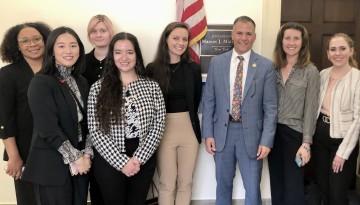
Twelve doctoral candidates traveled from the Ithaca campus and Weill Cornell Medicine in New York City to Capitol Hill April 17 for the annual Cornell Ph.D. Student Advocacy Day.