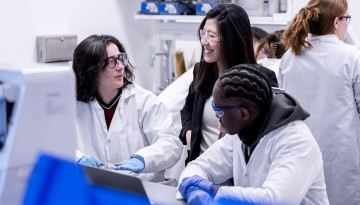
Scientists at the Cornell College of Veterinary Medicine have found that administering a rotavirus vaccine to newborn mice via a shot, rather than an oral dose, increases its efficacy, particularly for at-risk newborns.
Raw milk cheese products contained infectious avian influenza virus when made with contaminated raw milk, creating potential health risks for consumers.
The Center for Teaching Innovation published two series of adaptable case studies, from the Creative Teaching Awards and Provost’s Working Group for Innovation in Assessment, showcasing new Cornell faculty approaches to assessing student learning.
The team found a significant uptick in the number of articles published after 2013 that focused on core concepts and competencies suggested in a seminal report.
The Weill Institute for Cell and Molecular Biology will bring together leading scientists from across the globe and across disciplines for its 8th Biennial Weill Institute Symposium, Oct. 13–14. The two-day program, taking place in Ithaca, NY., will showcase advances in molecular and cell biology research, while fostering opportunities for Cornell students and postdoctoral scholars to connect with internationally recognized leaders in the life sciences.