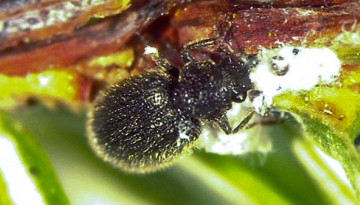
Cornell and the New York State Department of Environmental Conservation announced the creation of a new biological control lab on campus to protect the state’s ecologically important hemlock trees.
Five Cornell faculty members have been elected fellows of the American Association for the Advancement of Science, the world’s largest general scientific society.
Reducing antibiotic resistance in animals and developing a lubricating formula in joints for people suffering from arthritis are two of seven projects that received Center for Advanced Technology annual grants.
Jenny Sabin and Peter Lloyd Jones demonstrate new complementary and experimental approaches to the design studio and research in their new book, “LabStudio: Design Research Between Architecture and Biology.”
Cornell researchers have taken a major step toward answering a key question in cancer research: Why is testicular cancer so responsive to chemotherapy, even after it metastasizes?
Four teams of engineering faculty and students each received up to $20,000 from the college to advance their laboratory research toward functioning prototypes.
Dairy Day, a free event held twice a year by students in the Cornell University Dairy Science Club, is Nov. 3., 5:30-7:30 p.m. in the Livestock Pavilion.