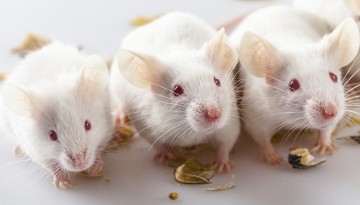
Cornell researchers have developed a technique for revealing how the motor cortex in the brain works – by focusing on a mouse’s tongue when it licks a water spout.
The College of Arts and Sciences has awarded 14 New Frontier Grants totaling nearly $2 million to faculty members pursuing research projects ranging from the physics of quantum computing to the design of new musical instruments.
Cornell engineers and plant scientists have teamed up to develop a low-cost system that allows grape growers to predict their yields much earlier in the season and more accurately than costly traditional methods.
Cornell engineers used laser pulses to control changeable properties in a quantum material, pioneering a method that may have wide applications across a class of materials with immense technological interest.
Cornell has become one of the first U.S. universities to partner with the council, communicating the benefits of wind power and providing industry research in more than 80 countries.
More than a hundred people gathered virtually at the end of April for the 2021 annual conference on the CCAT-prime project, which is building the Fred Young Submillimeter Telescope (FYST) in Chile. “First light” is scheduled for 2023.
More than 30 students presented their research on a wide range of topics during the 35th Cornell Undergraduate Research Board Spring Symposium, held virtually May 4-7.
The College of Engineering will grow the number of students it invites to its CATALYST Academy – a program aimed at inspiring minority students to study engineering – thanks to a $2 million gift from Peter Wright ’75, MBA ’76.