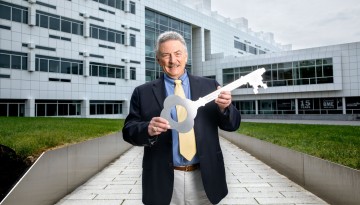
David Hysell, Ph.D. ’92, professor in the Department of Earth and Atmospheric Sciences, is using NSF funding to develop radar tools and techniques for monitoring space weather, including the creation of a new radar system at Cornell.
When Lou Walcer ’74 stepped into the new business incubator in Weill Hall 10 years ago, he saw opportunity. Now, the center has enjoyed a decade of success.
Using a microscope he developed, physicist Séamus Davis and his team have found an exotic state of quantum matter, originally thought to just exist in cuprates, in a more conventional type of material, which could lead to more discovery.
Designing a recycling strategy for a new generation of photovoltaic solar cells will add a strong dose of environmental friendliness to a green industry.
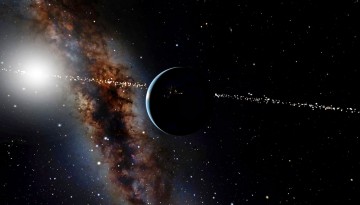
Astronomers have identified 2,034 nearby star-systems – within 326 light-years – that could find life on Earth by watching our pale blue dot cross our sun.
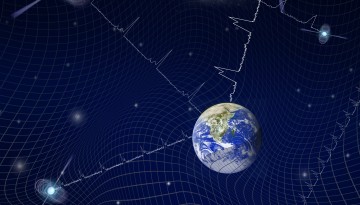
The funding will enable astronomy researchers at the North American Nanohertz Observatory for Gravitational Waves consortium to continue their search for five more years.
Francesco Sgarlata, a Klarman Postdoctoral Fellow in physics in the College of Arts and Sciences, is using his three-year fellowship to address the inconsistency of two pillar theories – general relativity and quantum mechanics.
Cornell researchers have developed a method of magneto-thermal imaging that offers nanoscale and picosecond resolution previously available only in synchrotron facilities.
Cornell researchers were able to stretch and twist individual molecules of a conjugated polymer and measure its mechanical and kinetic properties, gaining insights that could eventually lead to more flexible and robust soft electronic materials.