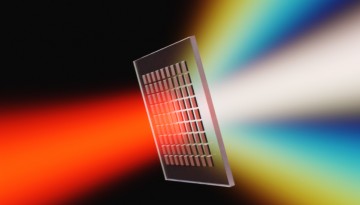
Cornell researchers have developed nanostructures that enable record-breaking conversion of laser pulses into high-harmonic generation, paving the way for new scientific tools for high-resolution imaging.
Justin Wilson has received a grant from the U.S. Department of Energy to develop more efficient methods of separating rare earth elements, which are found in wind turbines, liquid crystal displays, batteries, and portable electronics.
After stifling temperatures parked over the Pacific Northwest in late June, scientists – including Cornell’s Flavio Lehner – said climate change triggered it.
Amy Kaminski '98 is the editor of a new book about space science and public engagement and has a career that’s dedicated to helping people become involved in science research in a meaningful way.
A breakthrough imaging technique enabled Cornell researchers to gain new insights into how tiny ligands adsorb on the surface of nanoparticles and how they can tune a particle’s shape.
A Cornell-led team has used transdisciplinary systems modeling to calculate the future health benefits of vehicle electrification, driverless cars and ride-sharing in the United States.
Using observations of gravitational waves, physicists at Cornell, MIT and three other institutions have for the first time confirmed Stephen Hawking’s area theorem of black holes, which states their event horizons should never shrink.
An interdisciplinary team developed a tool to parse quantum matter and make crucial distinctions in the data, helping scientists unravel the most confounding phenomena in the subatomic realm.