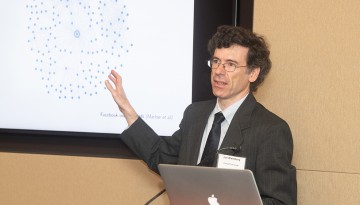
Mathematical and computational models can make power grids, financial institutions and other networks less vulnerable to collapse, Jon Kleinberg, the Tisch University Professor of Computer Science, said at a June 13 presentation on Capitol Hill.
The U.S. Supreme Court on June 21 overturned the 2010 conviction of Mississippi death row inmate Curtis Flowers, who was represented by Cornell Law School professor Sheri Lynn Johnson.
The Cornell Dairy Foods Extension certificate program run by the Department of Food Science in CALS helps industry people learn the ins and outs of product safety and quality.
A Cornell-led team has shown, for the first time, that intergenerational contact and education about the aging process and its misconceptions can reduce ageist attitudes, prejudices and stereotypes.
Cornell engineers have created a synthetic vascular system for soft robots capable of pumping an energy-dense hydraulic liquid that stores and deploys energy in an integrated design.
Cornell University and the Core Foundation have signed a five-year Memorandum of Agreement to explore new ways to promote food security and agricultural innovation in Latin America.
A Cornell-led team has developed a way to use machine learning to analyze data generated by scanning tunneling microscopy, yielding new insights into how electrons interact and showing how machine learning can be used to further discovery in experimental quantum physics.
Gender trainings sponsored by Cornell’s Delivering Genetic Gain in Wheat project are changing attitudes in East Africa and empowering women to take greater control of household farming activities.