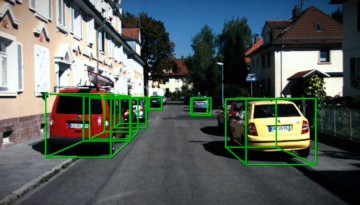
Cornell researchers have discovered an inexpensive and accurate method for self-driving cars to detect three-dimensional objects, potentially revolutionizing the autonomous vehicle industry.
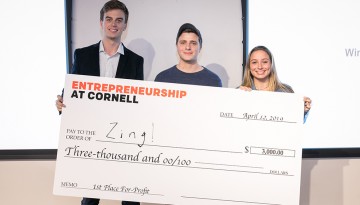
An idea for $1 rides to campus won one of several student business competitions that took place during Entrepreneurship at Cornell’s Celebration conference April 11-12. The annual event drew more than 700 participants for symposiums, awards and networking.
Experiments conducted at low temperatures and in a confined space revealed that a surprising polka dot pattern spontaneously appeared in the superfluid helium-3.
Two Cornell faculty members with expertise in psychology and evolutionary biology and have been elected to the American Academy of Arts and Sciences, the academy announced April 17.
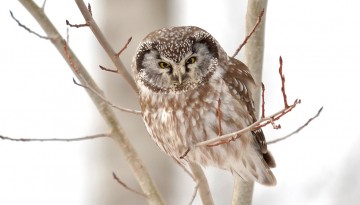
Cross-referencing a decade of Google searches and citizen science observations, researchers have determined which of 621 North American bird species are currently the most popular and which characteristics of species drive human interest.
Researchers have collected and analyzed health-related internet search terms from all 54 countries in Africa, finding that searches such as “Does garlic cure AIDS?” can reveal pockets of disease prevalence, cultural stigmas and urgent needs for accurate health information.