Cornell researchers have discovered a way to accelerate photons using four orders of magnitude less energy than existing methods, paving the way for ultraviolet lasers that can capture processes lasting a quintillionth of a second.
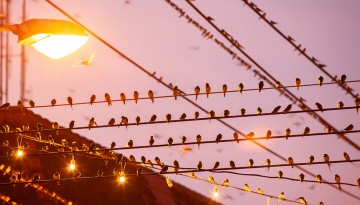
An estimated 600 million birds die from building collisions every year in the U.S., and research from the Cornell Lab of Ornithology offers one explanation for it: a combination of light pollution and geography.
Graduate student Teddy Yesudasan’s presentation, “What Makes a Red Potato Red?” earned him first place and $1,500 in the fifth annual Three Minute Thesis contest, March 20 in Call Auditorium.
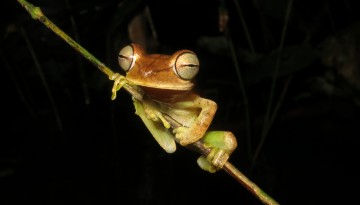
A fungal disease that afflicts amphibians has led to the greatest loss of biodiversity ever recorded due to a disease, according to a paper published in Science.
The university has created the Cornell Center for Social Sciences, and a faculty implementation committee will make recommendations for the creation of an organizational structure integrating public policy areas and the creation of “superdepartments.”
Ascribe Bioscience has become the first company based on technology developed at the Boyce Thompson Institute to receive a National Science Foundation Small Business Innovation Research grant.
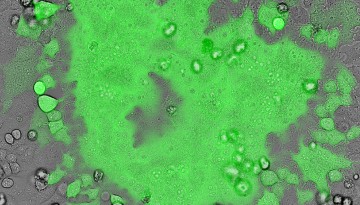
A research team led by David Russell from the College of Veterinary Medicine has pinpointed a novel angle of attack that could eradicate HIV reservoir cells – while leaving healthy cells untouched.
Researchers have developed a mathematical model to calculate blameworthiness on a scale from zero to one – a tool that potentially could be used to guide the behavior of artificially intelligent agents, such as driverless vehicles, to help them behave in a “moral” way.