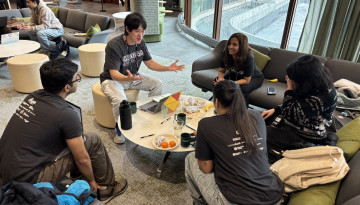
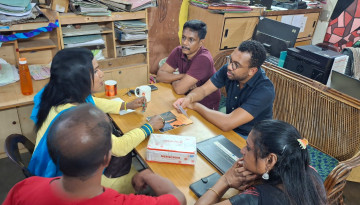
Engineering faculty and students traveled to Washington, D.C., for the inaugural U.S. Governors Cup Robotics Tournament, where they showcased a robot in hopes of inspiring young students.
In this week’s episode of Research Matters, Cornell professor Robert Shepherd explores a radically reimagined future of robotics – one built not from bolts and steel, but from living tissues, fungal networks and soft, 3D-printed materials.
A well-placed step can turn a high hurdle into an easier jump. The same idea applies to how nanoparticles transition into crystals, according to new research from the Cornell Duffield College of Engineering.
Fourteen members of Cornell’s faculty and staff are being recognized this year with Community-Engaged Practice and Innovation Awards from the David M. Einhorn Center for Community Engagement.
A Cornell-led collaboration used high-resolution 3D imaging to detect, for the first time, the atomic-scale defects in computer chips that can sabotage their performance.
A $1.2 million gift from Michael J. Kelly ’92 and Kristin Miljus Kelly will accelerate Menopause Health Engineering, an emerging research effort led by the Cornell Duffield College of Engineering.
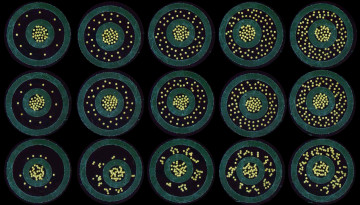
Researchers demonstrated how a swarm of microrobots spinning on a water surface can together generate the fluidic torque needed to manipulate passive structures without any physical contact.
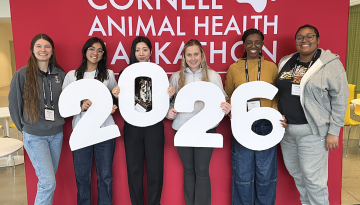
Products to fight ear infections in dogs, a parasite in cattle and animal population control challenges won top honors at the Feb. 20-22 Animal Health Hackathon at the College of Veterinary Medicine.