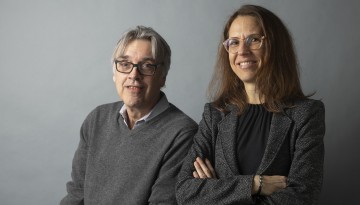
Richard Cerione, the Goldwin Smith Professor of pharmacology and chemical biology, and Claudia Fischbach, professor of biomedical engineering, discuss their collaborative research on cancer biology – the metabolic changes required for cancer development and cancer cells' interactions with other cells.
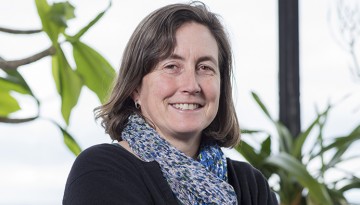
Climate change expert Natalie Mahowald will deliver the keynote address on removing atmospheric carbon at the 2019 Polson Institute Future of Development symposium.
A team led by Paul Steen, the Maxwell M. Upson Professor in Engineering, has created a periodic table of droplet motions, inspired in part by parallels between the symmetries of atomic orbitals, which determine elements’ positions on the classic periodic table, and the energies which determine droplet shapes.
For the first time, a Cornell Speech and Debate Society student team made it to the grand final of the World Universities' Debating Championships, held this year in Cape Town, South Africa.
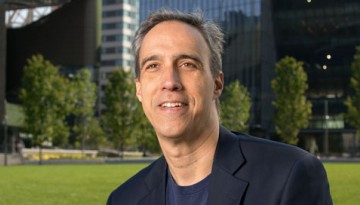
Dan Huttenlocher, dean and vice provost of Cornell Tech, who positioned the campus as one of the most forward-thinking and interdisciplinary in the nation, will step down Aug. 1 to become dean of MIT’s new college of computing.
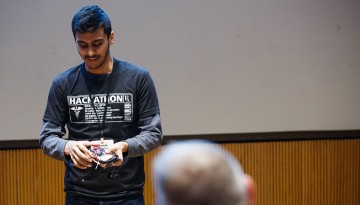
The third annual NYC Health Hackathon, hosted Feb. 8-10 by Weill Cornell Medicine, brought teams together in an attempt to solve myriad medical challenges.
If you’re planning a trip to Elysium Planitia on Mars, pack a sweater. Beginning today, NASA’s Jet Propulsion Laboratory will provide daily weather reports for Mars, courtesy of the red planet’s newest robotic resident, InSight.
Cornell professor Natalie Mahowald offered straightforward and hopeful testimony on Earth’s warming atmosphere Feb. 13 in a three-hour hearing on climate change before the House Science, Space and Technology Committee.
Cornell researchers have found that inorganic materials are able switch between discrete states almost instantaneously, bridging the gap between what’s known about phase changes in organic molecules.