Researchers at Cornell Tech found that people are far more likely to say they believe news stories that align with their own political views no matter what outlet they’re from. But when offered a cash bonus for accuracy, participants were more likely to trust the news stories that countered their views.
Known for its role in relieving depression, the neurochemical serotonin may help the brain execute instant, appropriate behaviors in emergency situations, according to a new Cornell study Feb. 1 in Science.
Creating new opportunities for industry partnerships and increasing engagement with the world beyond the lab could help researchers make a broader impact and meet grand challenges, said speakers at the “Deep Tech Eats Social Media for Lunch” panel, held Jan. 28 in the Upson Hall lounge.
A method intended to evaluate racial disparities in lending decisions can yield very different results depending on tiny changes in how it guesses applicants’ races, according to a new Cornell-led study.
Negative thermal expansion, or NTE, is a rare but important phenomenon, and Cornell researchers have developed a better “map” for finding NTE in materials.
Two Cornell Tech master’s students have developed a prototype for augmented reality headsets to help people who are deaf or hard of hearing navigate one-on-one conversations.
Citizen science databases can be inconsistent, but Cornell researchers have developed a deep learning model that effectively corrects for location biases, leading to more reliable predictions.
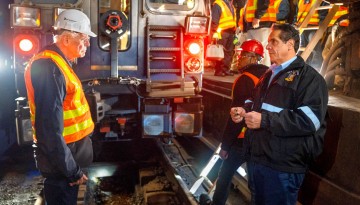
Gov. Andrew Cuomo has enlisted engineering professors from Cornell and Columbia to help solve a problem that threatened to cause an extended shutdown of a busy New York City subway line.