A group of five Cornell researchers - representing Engineering, and Arts and Sciences - has won a $1 million grant from the Keck Foundation for its research into topological superconductors.
Cornell materials scientists and bioelectrochemical engineers have created an innovative, cost-competitive electrode material for cleaning pollutants in wastewater.
A Cornell multidisciplinary team devised a way to get a "time-lapse" look at the early formation of mesoporous silica nanoparticles, from six-sided crystals all the way to 12-sided quasicrystals.
Researchers Andrew Myers, Elaine Shi, Greg Morrisett and Rafael Pass will explore a new approach that will make it easier to use cryptography to build more-secure systems.
Using a technique it devised, a research group led by professor Matt DeLisa has shown the ability to take membrane proteins out of the membrane and turn them into water-soluble biocatalysts.
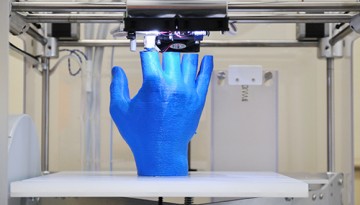
The Clinical and Translational Science Center, in collaboration with the medical student group Tech-in-Medicine, hosted its first hackathon, the 3-D Printing Innovation Challenge, over the course of several days in May.
Eight teams of entrepreneurs are spending their summer developing their business ideas into products at Rev: Ithaca Startup Works' Hardware Accelerator.
Cornell's Cislunar Explorers team has won the final phase of NASA's CubeSat competition and thus has earned a spot on a 2019 flight, in hope of completing its mission of a lunar orbit.
A new computer science course offered last semester explored the ethical and social issues raised by the emergence of robots and artificial intelligence.