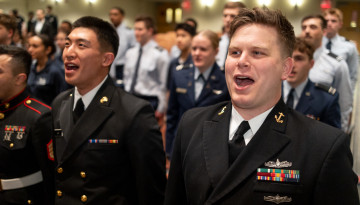
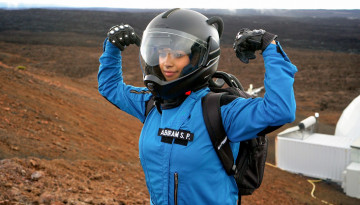
Two prior enlisted personnel were among 23 graduating Cornell seniors to receive commissions as second lieutenants or ensigns during campus ceremonies on May 21-22.
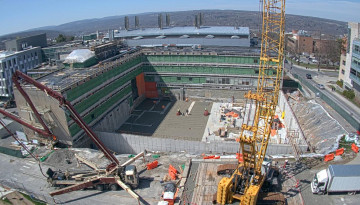
The buildout of a 10,000-square-foot quantum research facility at Cornell is advancing with a new $10 million investment from the Cornell Duffield College of Engineering, with an additional $3.5 million announced to support collaborative research projects.
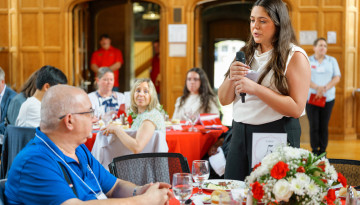
The 38th annual Merrill Presidential Scholars luncheon was held May 19 at Willard Straight Hall, celebrating the high school and Cornell mentors who inspired the latest group of scholars.
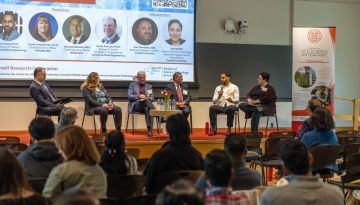
At a daylong event designed to promote academic-industry collaboration, Cornell’s Center for Advanced Technology in Life Science Enterprise cast itself as both a funder of early-stage research and catalyst accelerating connections that move discoveries foward.
Cornell engineers have developed a robotic collective that behaves less like a machine and more like a material that flows, reshapes and adapts to its environment without centralized control.
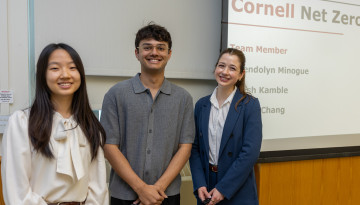
Gwendolyn Minogue’s journey through Cornell’s M.Eng. program in chemical engineering highlights how an interdisciplinary education can connect engineering, sustainability, data science and finance while empowering students to pursue unexpected career paths.
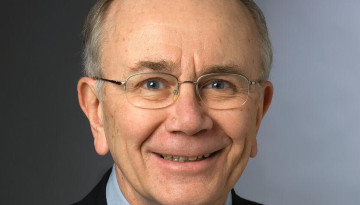
Albert R. “Al” George, the John F. Carr Professor of Mechanical Engineering Emeritus known for the race cars and student teams he championed as well as research and academic leadership, died May 6 in Ithaca. George was 88.
Five innovative immunology research projects have been selected for funding through the Cornell Center for Immunology's 2026 Multidisciplinary Seed Grants.
Complex health challenges require expertise from multiple scientific…