Cornell Engineering has announced its first three GE Aerospace Master of Engineering Fellows, who will each receive paid tuition for a one-year M.Eng. degree as well as an optional paid internship at GE Aerospace.
The Sibley School of Mechanical and Aerospace Engineering is celebrating 150 years of mechanical engineering at Cornell with a year of festivities that reflect on the school’s distinguished past and look forward to its promising future.
As world governments prepare the first-ever Global Stocktake, assessing whether they are living up to climate targets, Cornellians’ research is playing a critical role.
A research collaboration has found an efficient way to expand the collective behavior of swarming microrobots: Mixing different sizes of the micron-scale ‘bots enables them to self-organize into diverse patterns that can be manipulated when a magnetic field is applied.
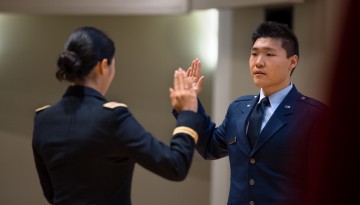
Graduating members of the Tri-Service Brigade received commissions to begin their military service – including the brigade’s first commission into the U.S. Space Force – at a May 26 ceremony in Statler Auditorium.
In a two-day celebratory program, Merrill Scholars recognized the high school teacher or mentor who most impacted their early education and the Cornell faculty or staff member who contributed most significantly to their college experience.
Cornell Atkinson will provide $1.6 million in seed funding to support research teams across nine colleges and 22 departments, many with external partnerships.
Natalia Urbas ’23 received this year’s Class of 1964 John F. Kennedy Memorial Award. She will use the $15,000 award funding to support underrepresented minorities interested in pursuing careers in research and technology.
The Graduate Diversity and Inclusion Awards recognized members of the graduate community for their accomplishments, leadership and commitments to advancing efforts around diversity, inclusion, outreach and student engagement.