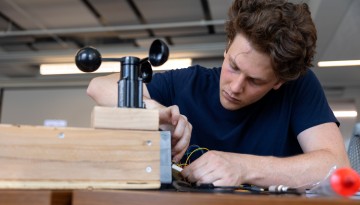
From monitoring blood pressure to potholes: Professor Max Zhang's Internet of Things (IoT) course teaches students how to leverage IoT sensor technology to solve real-world problems and help the community.
Three Cornell faculty members and a senior lecturer have been recognized with Kendall S. Carpenter Memorial Advising Awards for their sustained and distinguished contributions.
Researchers in the School of Electrical and Computer Engineering are incorporating elements of physics, circuit design, photonics, systems architecture, information theory and other fields to make quantum devices both practical and scalable.
A $1M award will support Upstate 2.0, which aims to grow the regional economy in upstate New York while helping to realize the state and nation’s goal of a net-zero carbon economy.
As part of a new cross-college initiative designed to accelerate engineering innovations in medicine, Cornell Engineering is piloting an M.D.-M.Eng. program that allows medical students at Weill Cornell Medicine to earn a one-year professional Master of Engineering degree.
The Big Red was awash in tie-dye May 8 as Dead & Company came to Barton Hall for a jubilant benefit show that had multiple generations celebrating the return of members of the Grateful Dead to the site of one of their most historic shows.
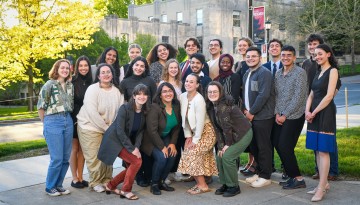
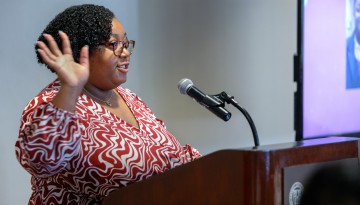
An enthusiastic audience of 100 Cornellians celebrated academic achievements and community at the Office of Academic Diversity Initiatives’ annual Honors Award Ceremony on May 5.