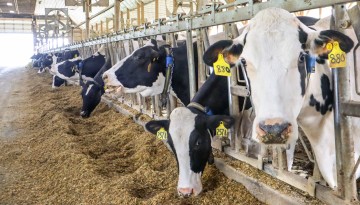
Cutting-edge, data-driven agricultural technologies and precision management strategies designed for the farm of the future will be developed, evaluated and demonstrated, thanks to a four-year, $4.3 million U.S. Department of Agriculture grant.
Megan Holycross, assistant professor of earth and atmospheric sciences at Cornell Engineering, has received an NSF CAREER award to research the origins of the Earth’s continental crust.
Mehrnaz Sabet, Mokshin Suri and Ruben Trujillo make up the latest cohort of the Cornell Engineering Commercialization Fellowship, a program that helps researchers evaluate their technology through a business lens.
In a first-of-its-kind analysis, Cornell researchers and partners at the Clinton Health Access Initiative found that pharmaceutical producers could reduce their environmental impact by roughly half by optimizing manufacturing processes and supply chain networks and by switching to renewable energy sources.
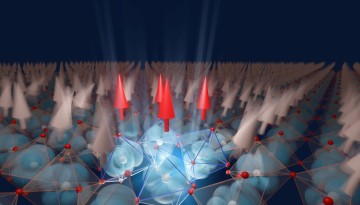
Using a precisely tuned, ultrafast laser, a Cornell researcher showed that the atomic structure of yttrium titanate could be changed to stabilize its magnetism at temperatures three times higher than was previously possible.
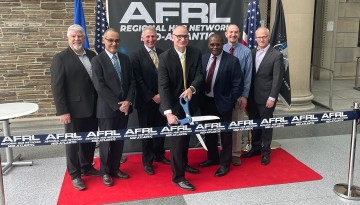
The event included a ribbon-cutting ceremony, remarks from AFRL Chief Technology Officer Dr. Timothy Bunning, and presentations from researchers who received funding during the Fall 2022 funding cycle.
New research from Cornell and the Smithsonian Institution deepens the geological understanding of Earth’s continents by testing and ultimately eliminating a popular hypothesis about why continental and oceanic crusts have contrasting compositions.