To celebrate its 20th anniversary, the Faculty of Computing and Information Science will host an academic symposium Oct. 2-3 exploring the history and future of computing at Cornell and around the world.
Eleven Cornell students worked all summer to move their businesses forward, thanks to the Marla and Barry ’90 Beck Entrepreneurship Fellows Program, which supports students in their entrepreneurial pursuits.
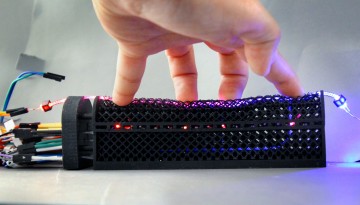
A new stretchable optical lace creates a linked sensory network that would enable robots to sense how they interact with their environment and adjust their actions accordingly.
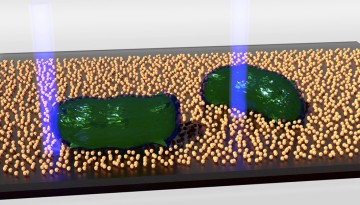
The U.S. Department of Energy has awarded an interdisciplinary team of Cornell researchers $2 million to study the combination of inorganic semiconductor nanoparticles and bacterial cells for more efficient bioenergy conversion.
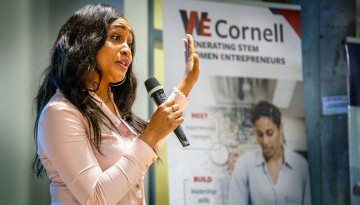
W.E. (Women Entrepreneurs) Cornell and Black Entrepreneurs in Training are programs encouraging and enabling underrepresented groups in entrepreneurship. The deadline for joining either group is Sept. 11.
Divisions between political parties are believed to reflect deeply rooted ideological differences, but a new study from sociology professor Michael Macy points to another factor: luck.
Doctoral students Stephen Roblin, in the field of government, and Laura Leddy, in the field of anthropology, have been selected as recipients of the Dolores Zohrab Liebmann Fellowship.
Educators across the country can now use Cornell-designed interactive tutorials to teach elementary and middle schoolers how to participate positively in social media – while simultaneously learning to navigate some of its potential perils.
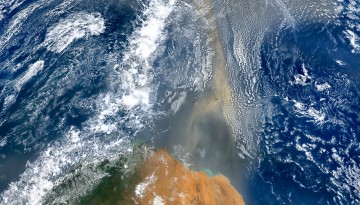
Buoyed by an atmospheric “superhighway,” smoke from lightning-sparked African savanna and forest fires deposit unexpectedly large amounts of nutrient-rich phosphorus in a river basin an ocean away.