Cornell hosted a two-day workshop in late June addressing criticisms of contemporary macroeconomics, organized by professor Kieran Donaghy with support from the Atkinson Center for a Sustainable Future.
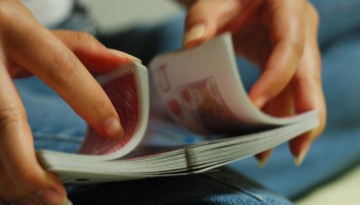
In a study designed to measure perceptions of inequality, Cornell researchers found that winners of a simple card game were far more likely than losers to believe the game’s outcome was fair, even when it was heavily tilted in their favor.
Cornell is launching the Engineering Management Distance Learning Program, which will allow working professionals to earn Master of Engineering degrees while remaining on the job.
A breakthrough imaging technique developed by Cornell researchers shows promise in decontaminating water by yielding surprising and important information about catalyst particles that can’t be obtained any other way.
Natalie Nesvaderani is one of 23 recipients of a 2019-20 Charlotte W. Newcombe Doctoral Dissertation Fellowship, administered through the Woodrow Wilson National Fellowship Foundation.
The U.S. Department of Agriculture’s National Institute of Food and Agriculture has awarded $1.8 million to two Cornell food science research projects.
By applying scientific principles used to create models for understanding cell biology and physics to the challenges of cosmology and big data, Cornell researchers have developed a promising algorithm to map a multifaceted set of probabilities.
Cornell engineers have created a synthetic vascular system for soft robots capable of pumping an energy-dense hydraulic liquid that stores and deploys energy in an integrated design.
A Cornell-led team has developed a way to use machine learning to analyze data generated by scanning tunneling microscopy, yielding new insights into how electrons interact and showing how machine learning can be used to further discovery in experimental quantum physics.