U.S. cities could see a decline in mortality rates and an improved economy through midcentury if the federal government maintain strong air pollution policies to diminish diesel freight truck exhaust.
Gallium nitride, a semiconductor that revolutionized energy-efficient LED lighting, could also transform electronics and wireless communication, thanks to a discovery made by Cornell researchers.
Robert Morgan, an influential American writer and one of Cornell’s most beloved professors, will be honored at a celebration on campus on his 75th birthday.
The “New Day at the MTA” conference, co-sponsored by the Metropolitan Transportation Authority, the Jacobs Technion-Cornell Institute at Cornell Tech and the Empire State Development Corporation, explored solutions for an aging transit system that moves 8.6 million people a day.
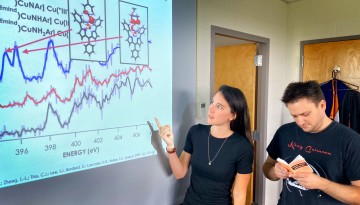
A collaboration between researchers from Cornell, Harvard, Stanford and the SLAC National Accelerator Laboratory has resulted in a reactive copper-nitrene catalyst that pries apart carbon-hydrogen bonds and transforms them into carbon-nitrogen bonds, a crucial building block for chemical synthesis.
Anthony Jack, assistant professor of education at the Harvard Graduate School of Education, will address diversity at elite institutions in a lecture Oct. 3 in the Biotechnology Building, Room G10.
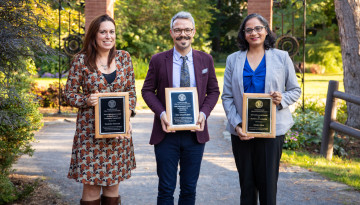
Four postdoctoral scholars were honored with Postdoc Achievement Awards as part of Cornell's participation in National Postdoc Appreciation Week. The awards recognize excellence in community engagement, leadership and mentoring.
Events this week include a climate rally, talks and films on climate change; a play depicting a soccer team’s coming of age; and a celebration of Korean language and culture.