Visiting artists and directors will join local artists, scholars and activists for “Feminist Directions” March 15-16 at the Schwartz Center, a public symposium with interactive lectures, performances and workshops.
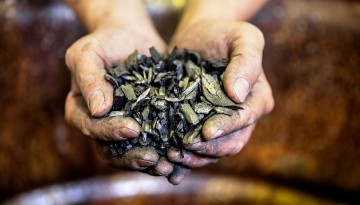
A Cornell-led study supported by the Atkinson Center for a Sustainable Future shows that biochar has great potential as a fertilizer because of its ability to soak up nitrogen, and its method for doing so.
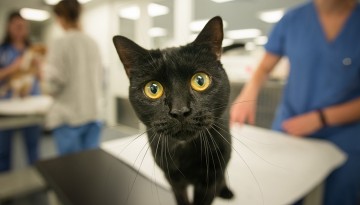
The Cornell College of Veterinary Medicine took part in World Spay Day for the first time on Feb. 23, and a total of 78 surgeries were performed, exceeding expectations.
Researchers at the Boyce Thompson Institute have discovered the mechanism behind the symbiotic relationship between plants and fungi, which could lead to reduced fertilizer use.
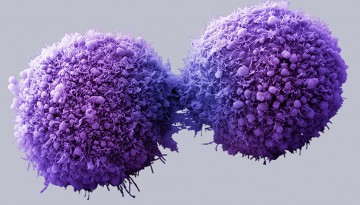
A Cornell-led team has discovered that at the onset of a rare liver disease, a small non-coding RNA molecule becomes silenced, a finding that may hold the key to treatment.
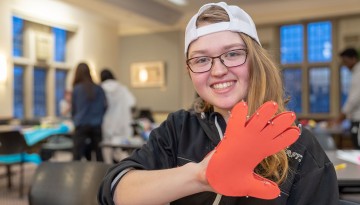
Using the five steps of design thinking, Diane Levitt from Cornell Tech gave a workshop Feb. 20 on how to work as a team to create rapid prototypes in an attempt to solve real-world problems.
Graduate student Michał Matejczuk has been named a Luce Scholar by the Henry Luce Foundation and will spend a year working in Asia starting this summer.
Researcher from Cornell and Virginia Tech have identified the process by which fungus is spread from plant to plant, carrying disease that costs billions annually in lost crops.
A team led by Paul Steen, the Maxwell M. Upson Professor in Engineering, has created a periodic table of droplet motions, inspired in part by parallels between the symmetries of atomic orbitals, which determine elements’ positions on the classic periodic table, and the energies which determine droplet shapes.