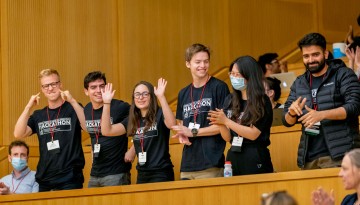
Students from 28 fields across six different schools gathered at the fourth annual Digital Agriculture Hackathon, March 11-13, to find solutions to global food system issues while competing for cash prizes.
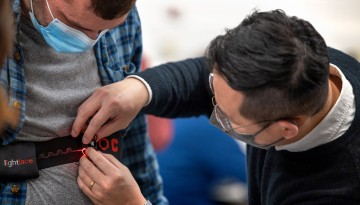
A Cornell startup is working with the Performance Apparel Design Lab to take its wearable sensor technology, which can track the movement of athletes, and use it to monitor pilots undergoing high-gravitational-force training.
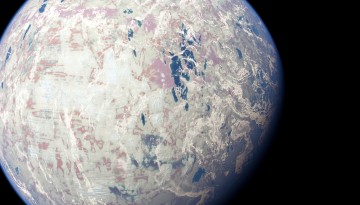
As ground-based and space telescopes improve, astronomers need a color-coded guide to compare Earth’s biological microbes to cold, distant exoplanets to grasp their composition.
New research from Manoj Thomas, marketing professor at Johnson, and Shreyans Goenka, Ph.D. ’20, finds that low-income conservatives are just as likely as liberals to accept federal assistance, so long as there’s a work requirement.
Faces transmit social information about goals and motivations that can help learners overcome the inherent difficulty of sharing a teacher's visual perspective, new Cornell psychology research finds.
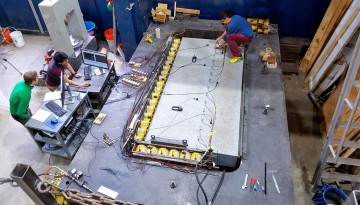
By examining earthquakes in a fresh way, a modeling revelation discovered in the lab by Cornell engineers helps science inch closer to accurate quake forecasts.
A team from Cornell Bowers CIS has developed AutoPhoto, a robotic system that can roam an interior space and capture aesthetically pleasing photographs through a machine learning process.
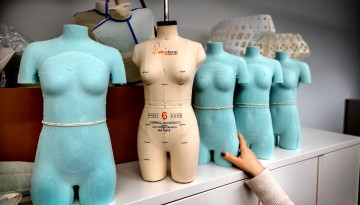
The technology, developed in the Department of Human Centered Design, aims to improve the fit and design of clothing and increase the sustainability of online shopping.
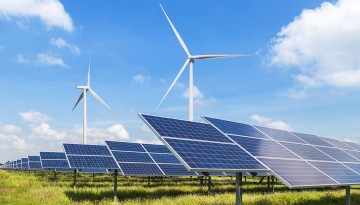
Cornell engineers have developed a new tool by combining machine learning and optimization modeling to provide hour-by-hour analysis of New York’s energy needs.