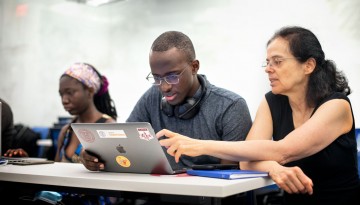
Diversity is a major priority of the Cornell Ann S. Bowers College of Computing and Information Science, and three summer offerings – CSMore, SoNIC and the Designing Technology for Social Impact Workshop – demonstrate that commitment.
A recent study published in PLOS Biology found that doctoral students who participated in professional development opportunities did not experience differences in time to degree or publication output from their peers.
A breakthrough imaging technique enabled Cornell researchers to gain new insights into how tiny ligands adsorb on the surface of nanoparticles and how they can tune a particle’s shape.
A Cornell-led team has used transdisciplinary systems modeling to calculate the future health benefits of vehicle electrification, driverless cars and ride-sharing in the United States.
This spring witnessed many projects to make Cornell’s learning spaces more inclusive, but what does it take to put great ideas into action for change? On June 25, over 45 participants from across campus gathered to hear from a panel of innovative graduate students and postdocs.
Students, faculty and staff were recognized for their commitment to diversity, equity and inclusion and excellence within the graduate community at the 2021 Graduate Diversity and Inclusion Awards and Recognition Celebration.
Doctoral students Monique Pipkin and Ama Bemma Adwetewa-Badu have been selected to receive 2021 Ford Foundation Fellowships. Honorable mentions were awarded to nine additional Cornell graduate students.
Cornell researchers have developed a method of magneto-thermal imaging that offers nanoscale and picosecond resolution previously available only in synchrotron facilities.
Researchers from Cornell Bowers CIS found no evidence that removing protected student attributes from dropout prediction models improves their accuracy or fairness, but they advocate for including those attributes.