Cornell researchers were able to stretch and twist individual molecules of a conjugated polymer and measure its mechanical and kinetic properties, gaining insights that could eventually lead to more flexible and robust soft electronic materials.
Many Graduate School students, alumni and staff have learned to use remote and hybrid environments to their benefit, creating a broader diversity of panelists and participants for online professional development programs.
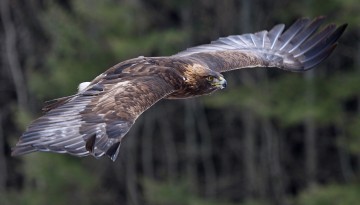
A Cornell-led collaboration used wind speed data and the measured accelerations of a golden eagle outfitted with GPS technology to show that turbulence is a source of energy that birds may use to their advantage.
Julius Judd, a fourth-year doctoral student in the graduate field of molecular biology and genetics, has been selected for the 2021 Harry and Samuel Mann Outstanding Graduate Student Award.
Cornell researchers have discovered a rare “pseudogap” phenomenon that helps explain how the superconducting transition temperature can be greatly boosted in a single monolayer of iron selenide, and how it might be applied to other superconducting materials.
Six graduate students were awarded 2021 Hsien and Daisy Yen Wu Scholarships. These scholarships recognize graduate students for their academic ability, performance and character as well as financial need.
Cornell researchers used dendrochronology and a form of radiocarbon dating called “wiggle-matching” to identify the ancient origins, and possible purpose, of a unique wooden structure in Northern Italy.
A team of researchers, led by Dyson professors Chris Barrett and Miguel Gómez, has developed the “Global Food Dollar” method, which distributes the consumer’s net purchasing dollar across all farm and post-farmgate activities.
A Cornell-led collaboration has been awarded a five-year, $3.6 million grant from the National Institutes of Health to explore the ways that the gut microbiome – that mass of microorganisms inside us all – impacts bone quality.