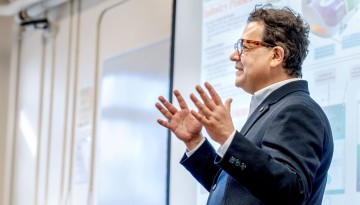
Faculty members are finding creative ways to deal with generative AI in their courses. Winners of Cornell’s 2024 Teaching Innovation Awards will discuss their approaches on April 11.
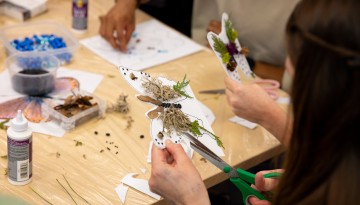
Campus and community members celebrated the environmental and literary legacies of former Cornell professor Vladimir Nabokov during events on campus March 14 and 15.
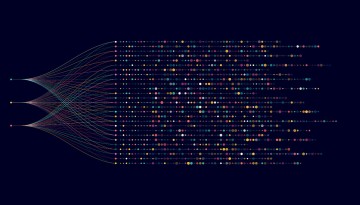
A new method can now find previously unknown factors that underlie disease by using statistical machine learning to sort through mountains of complex biological data.
New research suggests that when workers have more ability to find a new employer, businesses face higher risks of losing skilled employees who possess the expertise needed to implement new technologies, including machine learning.
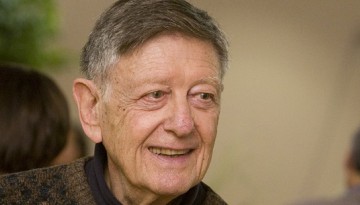
Gilbert Levine ’48, Ph.D. ’52, whose 68 years of service to Cornell were devoted to fostering multidisciplinary and international collaboration, died Feb. 5 in Fitchburg, Wisconsin.
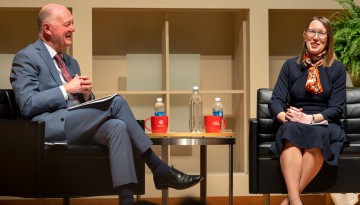
This year’s Lewis H. Durland Memorial Lecture, held March 25 in Statler Auditorium, was a conversation between two finance experts with opposing ideological views; it was tied to Cornell’s academic theme year, “Freedom of Expression.”
Hundreds of high school students from the across the country have been challenged to design a sustainable house for college credit as part of the Cornell course Climate Change and You, the Engineer.
The prize aims to “change the paradigm of neuroscience research by creating a community of next-frontier thinkers who can uncover a deeper understanding of the brain and cognition.”
Situated at the intersection of media and politics, Shiqi Lin's research explores how critical media culture can push open new spaces for social participation and how new forms of media can bring people together, particularly at times of crisis and radical change.